Dr. Suchita Malik Author of Indian Memsahib
An Alumnus of Lady Shri Ram College for Women, New Delhi
Excerpts from the Novels
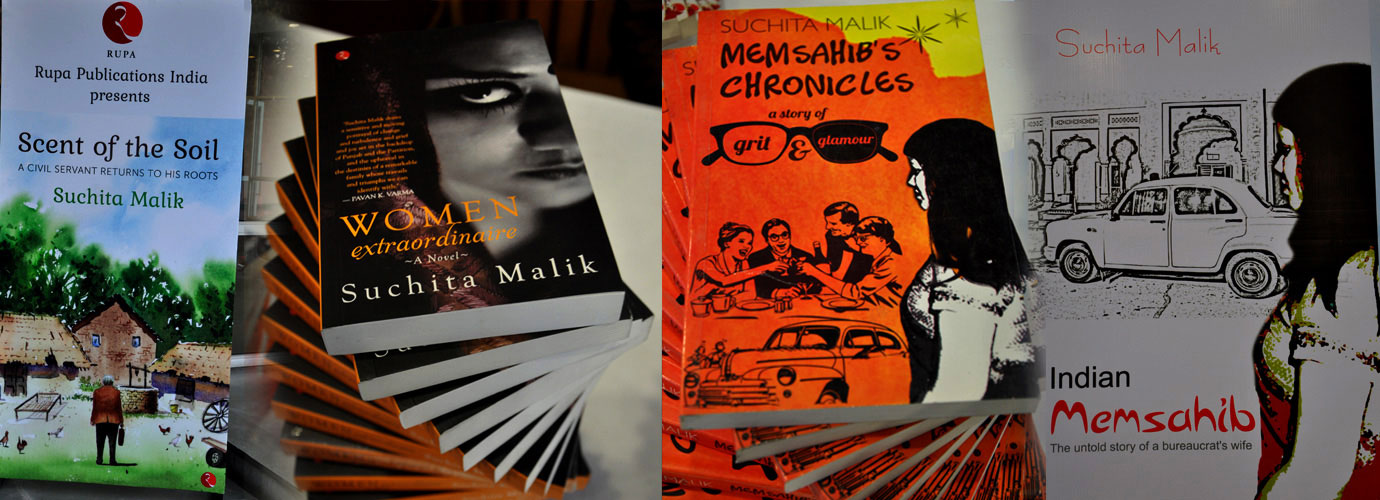
“Women Extraordinaire”
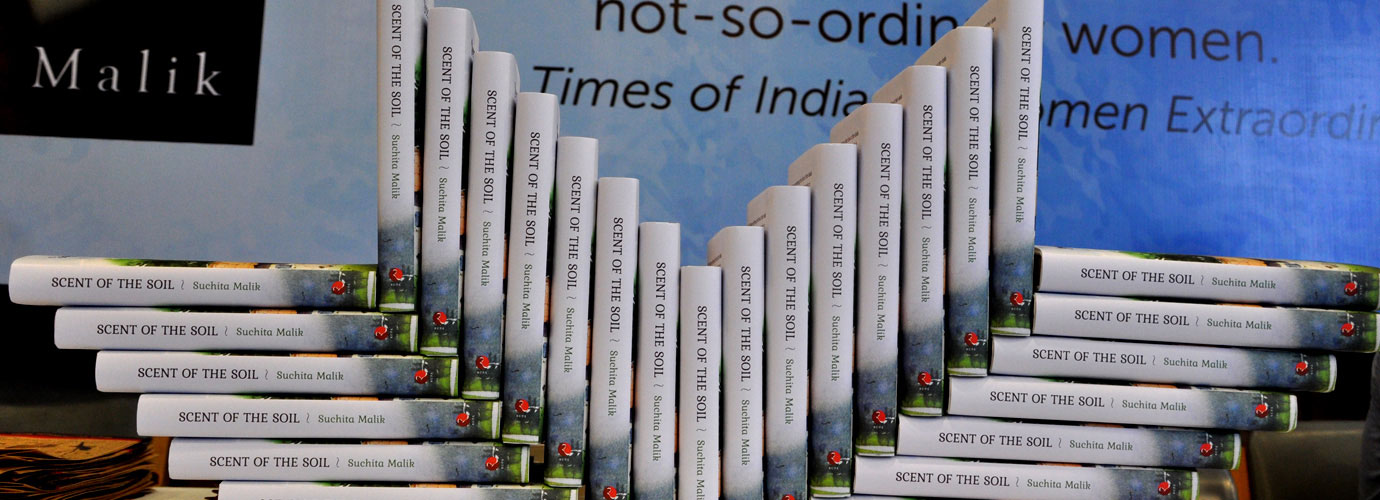
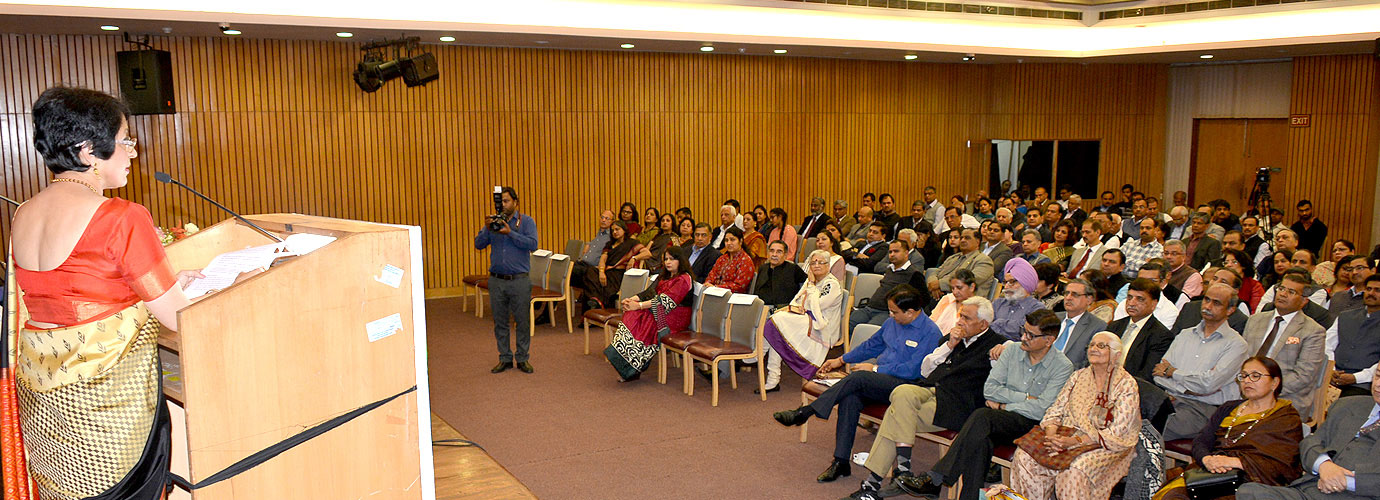
[Suchita Malik launched her third novel titled ‘Women Extraordinaire’, published by Rupa & Co., initially at New Delhi on 11th February, 2014, followed by its launch at Chandigarh on 1st March 2014.]
 “The theme and subject of my third novel is altogether new. It is not a story of some extraordinary women, as the reckoning would generally go, it is the saga of three generations of women living through the same vicissitudes of life as ordinary women do, but who stand out for their challenge to the orthodox views about women, stand up to their own convictions and thus become women extraordinaire,” holds Suchita Malik.
Talking about the plot, characters and writing style of the novel, Suchita said, “I did face the dilemma between keeping it a neat and clean narrative in the classical style of Thomas Hardy, Jane Austen, Bronte sisters or George Eliot on the one hand, and making it spicy with additives of some relationships or sex to cater to the current market trends. I chose the former. This novel can be read by a mother to her daughter or vice versa without any reservations.”
Spring was particularly beautiful in Dera Ismail Khan that year. Tender leaves were breaking out on the branches of trees, their redness lending radiance to the landscape so typical of the season. Rich flowers on the mango trees filled the air with an enchanting aroma and augured a bountiful crop in the days to come. Grooves of mango trees, called amrai, situated at some distance from the pavements, offered opportunities to passers-by to relax in their shade and soak in the subtle fragrance of the bloom with the breeze. The full-throated cooh-cooh of the ecstatic koel lent the music that was enough to send them into deep slumber in the lazy, elongated afternoons.
A fakir had once come travelling in the neighbouring area and happened to pass by their haveli when Jot Singh, who was coming out of his house on his way to work, saw him and invited him respectfully to grace his haveli and bless his cheerless home. Jot Singh and Subhagi sat at his feet with folded hands, their eyes full of pain and longing. They got up only when the fakir, taking pity on this childless couple and moved by their reverence, decided to bless them. It is said that a sage’s blessings do not go to waste. In a couple of months Subhagi conceived. She bloomed even in her middle age.And that, the parents believed, was how Kaushalya had come into this world.
The night was falling and everything was still in the house. Everyone sat silent waiting for the hakim to arrive while Jot Singh lay still on his bed and Kaushalya held his hand in a tight grip.
Shrieks burst out in the house of Sardar Jot Singh, the head of his family, who had just passed away on the eve of his departure for vilayat to fulfil the wishes of his one and only dear daughter.
Fate had struck its first cruel blow upon the innocent life of Kaushalya. Her world, once simple and secure, had fallen apart in an instant.
The trousseau was like a bevy of flowers; myriad colours and different shapes embellished with exquisite embroidery and sequin work. Fantastic strokes of gold thread made artistically had resulted in a splendour that lent a special charm to the chosen apparels.
Fresh flowers and human tears marked the wedding day of Jot Singh’s Kaushalya who was all set to traverse the path of the extraordinary destiny laid out for her by the Almighty.
As the night darkened, the flame of the diya lit near of tulsi plant burnt itself out and Geli Bai’s home was plunged into darkness. It was a darkness that their hearts and minds would never really grow out of.
For the second time in her young life, Kaushalya had fallen on hard times. The princess of Jot Singh had lost her moorings.
She did not feel any romantic love for Ganpat Rai; she did not think that would happen any time soon. Yet she also knew that being married meant there was a home and possibly other children in the future for her. ‘Isn’t that what every woman needs at the end of the day?’ She said to herself. ‘It is difficult to sustain love anyway. It has to deal with many obstacles in its way, human or divine. The world would have come to an end if all marriages were to be based on love. Love! Oh! When has that been the end-all of a successful marriage?’ Kaushalya could feel a change coming over her, as if she had matured beyond her years.
He was frugal in his habits and believed in living a simple life. He could be an ideal life partner for an ordinary girl but kaushalya was different. They traversed different mental regions; while one was fond of the fine and aesthetic things in life, the other was yet to find his particular interests and leanings. The disparities were marked and constant; and subconscious comparisons with Ramchander rendered the task of adjustment a rather long process. If it was a marriage of convenience for Kaushalya, Ganpat Rai had agreed to the proposal purely out of a sense of duty or responsibility. The question of love had never occurred to either partner and could never be the basis of their union.
They were like two heterogeneous elements yoked together by both society and their fate.
Their home had become the dearest place on earth for her; she loved the little baithak and the quaint kitchen where children tramped about; the dim lighting of the books area; the peculiar silence of the corners where the table lamps stood. She loved the appetizing aroma of the wheat rotis coming out of the smouldering chullah; the cosiness of their family. She loved Geli Bai, her mother-in-law, with her worldliness and practical wisdom; and her sisters-in-law, with their unflinching support and affection. She loved Ganpat Rai for his cooperation so that she could have her way in most things; and most of all, she loved her children, who were all equally warm, lovable and loving, who lit up the house with their uninhibited laughter. Kaushalya would not give up this bliss for anything in the world.
The train journey came to an end as they neared the periphery of the Sindh River. A new experience awaited Shobhna as she boarded the steamer that would take them through the river to the other part of the large land that contained the memories of her forefathers’ lives.
Kaushalya, meanwhile, stayed in her seat and watched the sunset, which to her appeared like a ball of melted lead. She felt as if she had crossed eternity in trying to get back to her roots. She had come a long way and felt much older. She looked at Shobhna and felt like crying. She wanted to protect her; protect her against all the uncertainties of life. She wished she could stay with her forever or keep her for all times to come! Her eyes were welling up with tears.
Shobhna felt a strange bond with the house. It was the house, after all, where her ancestors had been born and lived. She belonged to them as much as they belonged to her. Fascinated, she watched the interiors of the house and the surroundings in the faint brightness of the atmosphere. Shobhna felt a strange emotion overcoming her spirit, the dormant love for her roots becoming active suddenly in a moment. Kaushalya watched her daughter’s face intently and understood the feelings writ large on her face. She had also always loved the house, for it was here that she became a wife and a daughter-in-law. Kaushalya and Shobhna, both were bound to the same house like an infant to her mother with an umbilical cord.
The family sat together in the courtyard, united in grief. Geli Bai rested in the middle of the front veranda and lay like a historical monument. Never again would their household be the same without her formidable presence, her quiet strength and her uncanny commonsense. The spoke of the wheel in their household was gone. She went away after laying down a firm foundation for the progress and growth of their family.
Kaushalya felt a pang in her heart. How she wished Geli Bai was still alive! She realized her worth now, after she was gone. She longed to tell her mother-in-law how much she respected her; she wanted to chat with her about casual, mundane things; she wanted to spend time with her, enjoy her company; she wanted to touch her feet, for once, not out of formality but respect. Only if she could do it once, it would make up for her indifference towards her in the past. Kaushalya wanted to atone for all her neglect of homely duties. She regretted not letting Geli Bai know how much she respected her, how much she depended on her. Geli Bai was the sun around which their family revolved!
Overnight the nation plunged into the throes of mania. People went hysterical as the news of the country‘s partition spread like wildfire. Emotions ran high in both parts of the affected nation; caution was thrown to the wind by the frenzied people.
The anger of the moment manifested itself in many ways of carnage; the bitterness, the hurt, the deprivation drove away any feelings of decency or gentleness. People stood anchorless and watched everything burning around them, getting frantic to run away to safer alternatives and save their lives. ‘Life can be started again even in a foreign land among unknown people if precious lives were saved. Family can be united again, occupations found and built with time once again,’ they thought.
Was it possible to live with the dreadful pain of having lost everything, not knowing where destiny would take them? How could they rebuild their lives without the solid foundation of their memorable past? It wasn’t possible! It couldn’t be done! The future generations would never know their golden past, their inherent values, the antique belongings of their grandfather and great-grandfather. How could they sift through their memories? Questions haunted their hearts.
Anmol looked at Shobhna, Kaushalya, and his daughter, girls and women of three generations, all tied to him inextricably. He saw and perceived happiness in its purest form, the delicate thread of relationships as its progenitor and source. The essence of life did stem from these, he thought, only known to those who have experienced it personally. ‘Oh God! I can’t thank you enough!’ he uttered in prayer.
These were the three generations of women, two of them already proving time and again their beauty as well as strength, and the third one, newly born, with her whole life ahead of her. What a spectacle! Anmol said another prayer, asking God to bless these women for their strength of character, femininity and the courage of their convictions. In their mighty presence Anmol felt subdued.
She thought of her life, how it had been an eventful journey, where her relationships were like destinations and she had to give and take, before she could move on to the next junction. Joy and sorrow were intricately woven in her life and she had grown because of it. She looked at her fellow passengers, at the fast fading view and objects from the moving train, she looked at the dim twinkling lights outside whenever the train passed by a village or a city or any platform. Was she dreaming or was she wide awake? The images were blurry, even her thoughts. She continued to be in this kind of haze for some time before she fell asleep; the tide of life around her slowed down a little, bringing silence and darkness.
All the three sat on the bed in silence. The children thought of their last meeting with Nani, her kind face shining and bearing an enlightened look, her keen but curious gaze, her vibrant nature and her entire persona oozing out a rare charm and beauty. They would never forget the stories and anecdotes she would relate to them when they were small and would visit Dhanbad during their summer vacations. She had been an icon of progressive thinking for her entire family and clan.
‘Control Yourself, Shobhna!’ said her father. ‘Everyone has to go one day. This is the law of nature. We must accept it fully.’
‘I am not a saint like you, Father! Nor do I want to be one. My mother craved for your affection and companionship all her life and she never got it.
The affectionate face of Kaushalya Devi flashed before her mind’s eye again and again; their inseparable friendship of her school days, their carefree interaction and their dependence on each other; everything had come to an abrupt end suddenly. ‘Oh, Ma! Why did you have to go so soon?
‘Tell them that an era has come to an end with the death of their nani. She was a great Indian woman… A true follower of Swami Dayanand Saraswati!’ Ganpat Rai broke his reserve for once as everyone looked at him in utter amazement.
‘Yes, I am happy too,’ whispered Nayantara, tears welling up in her eyes suddenly. ‘I am happiest when I am with you. I just wait and wait for the time when we will be together always.’ They were walking from the library point towards the Academy after having a quiet candlelit dinner at the Whispering Willows, a popular place frequented by officer-trainees on the weekends. As they walked hand in hand in the dark by the roadside, Bijoy, flooded by passion for his beautiful, young wife, clasped her very close and showered her with kisses.
Everybody in the house was silent. A deep sense of gloom pervaded the atmosphere as never before. A great hush had descended over the stone walls as well as its inhabitants. Their eyes sported a look of bleak temerity trying to pierce through the vacuum of unanswered questions. It appeared as if the agony of the troubled souls, which remained stifled for want of expression, wanted to gush out through monosyllabic shrieks.
The coffin arrived as expected, draped in the tricolour and carried by the pall-bearers. The departed soldier was accorded a hero’s welcome. The air ranted with the shouts of ‘Major Abhinav amar rahe!’ (Long live Major Abhinav!). The kith and kin wailed inconsolably. The uncontrolled emotions of people had let go of all inhibitions, banishing any sense of reason, if any, at that point of time. The mob sentiments and fury was at its peak. Everyone wanted a glimpse of the ‘valiant’ who had made the supreme sacrifice for his motherland.
Shobhna’s mind suddenly went back to the gentle and calm face of her father, Ganpat Rai, when he had sat unnerved by the side of the dead body of his second son, Anand Prakash. Shobhna found that it was only now that she could actually comprehend the significance of her father’s words in totality when he had uttered, ‘Every fruit falls from the tree on the earth; some fall ripe, others are shaken or snatched away by the forces of nature, incomprehensible to mankind.’
Nayantara looked at the weather-worn face of her aging mother and admired her cool strength of character; a mix of the qualities of her grandparents; gentle, god-fearing, vivacious, strong, tenacious, marvellous, extraordinary and full of grace when under pressure. Yes! Shobhna had become a mirror image of her mother, Kaushalya Devi, ready to fight or live life on her own terms without crumbling under pressure from the cruel hand of fate.
‘What extraordinary women and what interesting lives!’ thought Nayantara, herself firmly on the same path as shown by her mother and grandmother both!
‘All said and done, life is still worth living and fascinating. I would like to be born again and again and live, live and just live…,’ Nayantara got up and hugged her mother tightly as Anmol and Bijoy looked at them silently, trying to understand the unbreakable bond that had always existed between the mother and daughter of this extraordinary dynasty. Perhaps they never would.
| Tweet | Follow @Dr. Suchita Malik |