Dr. Suchita Malik Author of Indian Memsahib
An Alumnus of Lady Shri Ram College for Women, New Delhi
Excerpts from the Novels
“Memsahib’s Chronicles: a story of grit and glamour”
[ Second novel by Suchita Malik; Published by Rupa & Co. Released in Feb. 2011 at New Delhi]
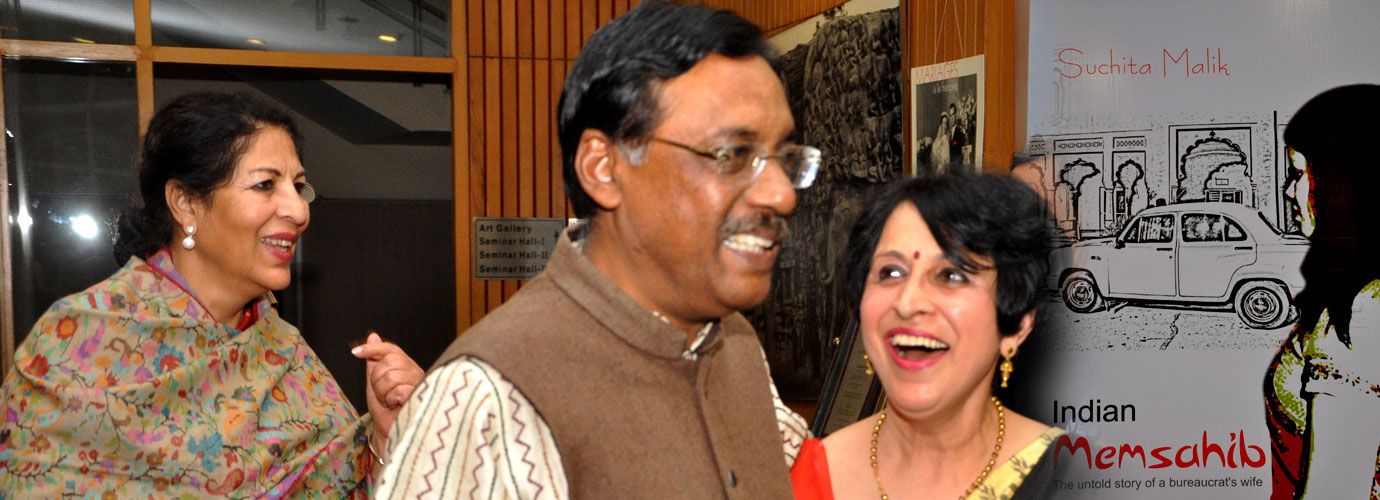
 Raghu and Sunanina, the protagonists of ‘Indian Memsahib’, continue to retain the centre-stage in this book, being a sequel. The female protagonist is also the narrator of the story knitted through a number of episodes. It is a bit different from the debut novel as it alternates between the comment on serious business and the glamour of the better-halves as she observes. The book presents the amazing world of the civil servants as it is – full of grit, glamour, tensions, temptations and privileges. Glamorous and gutsy, the highly adaptable memsahibs constitute the backbone of the world of sahib-log without letting them bother much on the domestic front. The author takes the reader along her journey with the ease of a garden walk.
The car raced along the road causing everything to give way before it and rush by, leaving all moving objects behind, weaving around them skilfully.
The scene outside was casual and non-descript; bundles of carefully bound wheat lay in heaps all over the fields. It was as though a sheet of gold had been laid out on a parched land. Vast stretches of freshly harvested land raced by, giving the impression of a vast prairie with nothing to block its view or mar its peculiar, arid beauty. Few people were out in the heat and one could see almost no livestock or industrious farmer anticipating a rich harvest.
After spending two decades and a half as an integral part of the illustrious service, she could now judge it and wanted to be fair to its character and nature. She was privy to the hobnobbing within the corridors of power, the nature of its meetings, the procedural delays, the tensions, uncertainties and frustrations a bureaucrat underwent in a career of varied postings and departments, She had seen them elated and depressed, comfortable in a high-powered cushioned posting or reduced to a glorified clerk when out of favour; she had even seen them jittery or confused, or resigned and stoic. Yet they had endured it all, braving all odds and surviving all ups and downs, leaving behind a trail of decisions, policies and controversies affecting the lives of millions of their countrymen and alluring the mind and psyche of the people with their power-packed performances.
‘Keeping his lips sealed with huge dollops of restraint was a part of his work-culture and ethics,’ thought Sunaina with a smile.
That’s what it was! Bureaucracy was like a river of life, made up of drops of water all alike and tied with the thread of hierarchy. Take away the higher and lower rank of distinction and the result was promiscuous mixing-in of all the company, the lack of reserve in manner. Sunaina was getting weary of it, weary of it all.
Sunaina felt, at times, there was a part that Raghu always longed to keep to himself. Given a choice, he would like to hold back certain things in the man’s domain and not share them with anybody else, not even his wife. He had this aloof side to his ‘official’ life which Sunaina considered a breach of faith between the partners. For her, marriage was total trust in each other with no sham barriers between the personal and the official lives.
‘Look at the scene outside, how beautiful… how can you always think of the inanimate infrastructure made of concrete, bricks and what not? Don’t these things bore you at times? I guess animate things interest you less…’
‘By animate things, you mean… your grass and flowers and birds and trees. Isn’t it? Laughed Raghu.
‘No, I mean, in general. See what’s happening around… many times nature is sacrificed at the altar of development for humanity’, persisted Sunaina.
She had never nurtured a longing to make a conquest of him in the traditional sensuous sense but always tried to bring in a kind of fresh breeze in their marriage in the form of independent ideas and an objective way of looking at life along with him. This was her way of offering herself with love and best intentions and as long as she could do it, there was no danger of her betraying her beloved Raghu.
‘Could a man ever understand a woman’s world and her need for constant delicate words and feelings? Was she a fool to think so? Do other women, too, crave for articulation of the finer feelings? Why do men get inexorably fixed in routine and lose interest in personal lives? Sunaina shuddered at the habituality of life and home.
Manoeuvring, politicking, self-interest, gossiping, networking and a cold, heartless formality had come to mark the scene of Indian administration and polity and all Raghu could do was to look at this seamy side with disinterested eyes while still contributing his bit for what he considered was the faceless humanity.
Memsahibs, all flushed with excitement and energy, looked at one another, giggled and walked towards the sumptuous winter bonanza. Sunaina couldn’t help thinking the strain of living a cultured and a monitored public life for a lifetime was a burden that could indeed be shed in moments such as these, where no eyebrows would be raised or a verdict passed on them if propriety and etiquette were forgotten for some time in an attempt to be their normal selves. After all, they had a right to express their innermost feelings and want to behave in an utterly idiotic and foolish way at times. ‘Why should anybody care if Rosie’s net blouse was a see-through or Sonam’s noodle-straps showed more of her plump shoulders or Ronita preferred to wear that famous little black dress to the delight of all the weight-watchers? Why shouldn’t they smoke, if they so wanted… why shouldn’t they wine and dine like all the other merry-makers…? Wasn’t that considered normal for the rest of the world? Why should only they or their clan be criticised for wanting to do all that? Wasn’t it absolutely all right for wanting to be freed from years of the monotony of social decorum for a few moments?' thought Sunaina with an overwhelming gulp.
The rich atmosphere had everything – the feeling of love, sweet fragrance of fresh flowers, the combination of elegance and power, a ravishing beauty dancing in ecstasy to the notes of love and a husky-voiced compere extolling the beauty of the season. The programme was a delight and left everybody elated and wanting for more. The memsahibs shone in radiance and beauty, putting all the earthly jewels to shame. The celebration of vasant-ritu had certainly enriched the overall ambience.
It was a lovely spring. Sunaina loved to wander around the city and its beautiful gardens to enjoy their fresh fragrance and the bloom. Nature and its beauty was always a deep mystery to her and nearness to it was the surest way for communion with god. From far off, somewhere, there was always a voice calling the human beings and beckoning them subtly to remain in its vicinity.
Her mind and heart danced with mixed thoughts and her head swirled in a meditative vigil. The flux of time and the fixity of the bureaucracy influenced her thought process to a great extent. The calmness of the environment set her mind in extraordinary agitation, ironically, and she pondered over the all-pervasive deluge of time and the turmoil faced by civilisation in its struggle for existence. Bureaucracy, no doubt, was like a big clock that continued to tick but the need had arisen, from time to time, for it to be wound up and enable it to keep pace with the changing times.
It seemed strange to Sunaina now that individuals mattered so little in this setup. Rather, they hardly mattered at all. But the system was full of them: some were dedicated, others indifferent; some friendly, others arrogant; some were zealous and conscientious, others casual or ordinary but they were all a product of their environment and human association.
It was becoming increasingly hard for Sunaina to get out of that sombre mood. Her own thought process, too, had to come round a full circle. She saw the intelligentsia and the glitterati both, she saw the close-knit cohesive crowd that held the reins of the country’s administrative setup. She smiled sardonically when she observed how, merely by crossing the elusive threshold of that exclusive circle they formed, the perspective instantly changed into a complacent arrogance. And the beautiful image, for Sunaina suddenly acquired different connotations.
Sunaina watched these civil servants, as they all sat around, reclining and discussing office politics, and observed how the system had sucked the passion out of the once-young radical personalities. As these babbling babus sat languishing in their lawn chairs, they discussed not the changes they had brought about in the system but the technicalities of politics of the office space. Sunaina came to a realisation amidst the indulgent laughter that the patriotic radicalism of their youth had dissipated into the air, just like the smoke of their cigarettes, as it swirled and faded, forgotten, into the air.
‘Yes!’ Sunaina told herself, ‘the system had changed them, rather than they the system.’
And so, Sunaina was, as ever, stuck at the boundary of this circle still – one foot inside its lavish exclusivity and importance, and some unnatural force propelling her outwards, as if merely an outside spectator to their ostentatious lives. What they did, or did not do, affected her sometimes, but there was a recalcitrant, almost centrifugal force that caused her to observe this world from the outside. She was in the system then – very much a part of it – but she resisted all attempts to be absorbed in her entirety and that, perhaps, made all the difference in the world.
‘Oh, well!’ she still ruminated, ‘it is not for me to bother about these things now. Let it be someone else’s headache in times to come!’ not realising that the system had claimed her, too – if only vicariously.
Still, she was a memsahib no doubt, but also an irrevocable feisty commoner at heart.
| Tweet | Follow @Dr. Suchita Malik |