Dr. Suchita Malik Author of Indian Memsahib
An Alumnus of Lady Shri Ram College for Women, New Delhi
Excerpts from the Novels
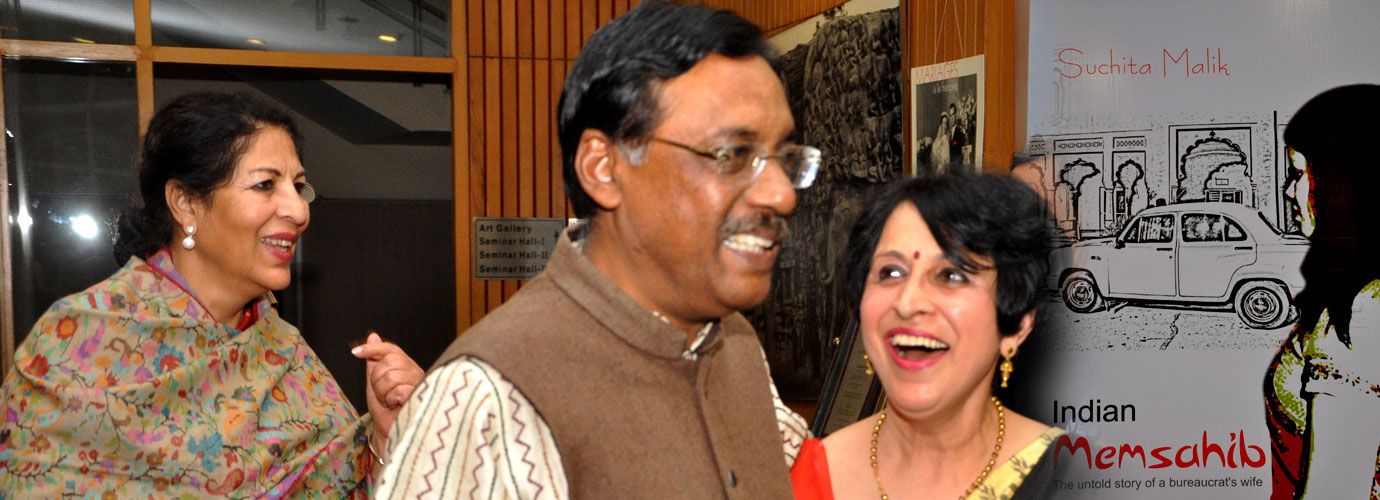
“Indian Memsahib – the untold story of a bureaucrat’s wife”
[Debut novel by Suchita Malik; Published by Rupa & Co.; Released in December 2008 at New Delhi]
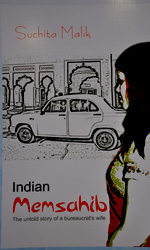 This debut novel is an untold story of a bureaucrat’s wife, which provides an unconventional look into the world of Indian Bureaucracy. ‘Indian Memsahib’ lifts the veil off ground reality a little bit; it is a peep into the life of a bureaucrat’s wife, a life that is full of excitement, struggles, challenges, apprehensions and all the ups and downs that define the nuts and bolts of babudom.
The novel takes one through the fascinating life journey of a bureaucrat’s wife - she wants to be more than a trophy wife of a civil servant and struggles to come out of its shadow. Ultimately, she is faced with an identity crisis as she asks herself as to which world she belongs to --- her own career or that of her husband. The novel remained on the best-seller list and has been through four reprints.
AS THE STATE ROADWAYS BUS LISTLESSLY SCURRIED THROUGH the rural settings en route the Delhi-Rohtak road, Sunaina found herself intently watching the mud-houses on both sides of the road, the dirty waterlogged lanes of the villages, the slush, the parrying of cows and buffaloes in the front courtyard of houses, and covered her nostrils against the stench and foul smell emanating from the dunghills. As the bus rattled along, she saw men-folk languishing in the open, reclining on their khats, with toddy for company, while, some indulged in a game of cards with a hookah occupying the centre stage.
The Bus had barely covered some distance to reach what looked like another village when, looking out of the window, she spotted a group of women, clad in the most colourful ghaggra-kurtis with earthen pitchers or shinning brass toknis balanced on their heads and a folklore on their lips. Sunaina was amused to see their careful balancing of steps with a practiced ease that only a combination of routine and necessity could bestow.
She saw some other women working tirelessly in the fields with a sickle and hook in their hands; she could see others hurrying towards their homes with a steady gait along with bharotas (bundles) of green fodder sitting heavily on their heads. The scorching heat of the sun, their hurrying speed and the effort of such an exercise lent a touch of pathos to the predicament of women in the ‘liberated and modern’ India of our dreams and leaders, pondered Sunaina, a little pensive.
The picture of the strong woman that emerged in her mind was that of one who got up at four in the morning, ground wheat in her chakki, prepared saani (fodder) for the animals, prepared the butter and the buttermilk, cooked khichdi or prepared roti for her family, before hurrying straight to the fields for a grueling day, only to come back home at dusk and busy herself with the same routine. Yet the reward, as was the common perception, could be a cruel physical beating by an idle philandering husband, the atrocities of whom she would tolerate with an equally formidable stoicism. Her life, thought Sunaina, bore resemblance to the substance ground between two parts of a chakki where she gradually and painfully ground her life to a final halt, ultimately.
The fashionable, bubbly, vivacious girl from Delhi had found it hard to take in her stride the snide, smug, smashing indifference of this ‘local’ rustic jat boy whom she had never even cared to notice a short while ago. She also felt appalled at the inanity of the local culture and their insensitivity at refusing to make the newcomers feel at home in their insipid surroundings or setup.
She sat cross-legged behind him and the scooter sped towards the opposite direction. Soon they reached their destination – a beautiful, artificially created serpentine lake spread over a large area amidst a rich green cover. They walked by the lake, side by side, enjoying the cool air, looking occasionally at each other, feeling a little shy and awkward. The cool breeze soothed and embalmed the rich, aromatic atmosphere and the thoughts in their minds danced with romance and joy. Suddenly, as if overcome by emotion, he took her hand and kissed it gently. Sunaina was dumb-struck and stood unsure for a few moments until the twinkling lights of the restaurant nearby brought them back to reality.
RAGHU’S FATHER, THE PATRIARCH OF THE FAMILY SAT IN THE verandah with his head held high, lips twisted as if in a frown and the eyes half-closed, immersed in deep thought. His deep inhalations of smouldering hookah made a loud sound of ghar-ghar as he made half-hearted attempts at reading the newspaper that lay scattered all over the charpoy before him.
The women of the house went about their business quietly and placidly. By now, they were so used to this routine that they found nothing amiss or objectionable in this and accepted their fate with a calm fortitude, readily supplying cups of tea hour after hour with mechanical poise. A lifetime of toil, labour and neglect had conditioned their bodies and minds so much that they limited themselves to their domestic domain alone and refused to partake in anything that did not concern them.
Sunaina felt isolated and alienated and desperately longed to share her innermost feelings with someone. But there was none who could understand her.
In an indulgent moment, Sunaina tried to remember her own imaginative renderings of an idyllic village set-up, her fanciful perception and thoughts about the pastoral life and laughed aloud at her foolhardiness. As per her imagination, a village was an inhabitation always situated by a riverside with vast stretches of sand in between and with tall, green foliage all around. She had created an image about life and existence in the rural setup in her mind and was ill prepared for the real version of it.
Would she ever be able to like all this …. this supposedly simple, down-to-earth, mundane existence with eyes prying on you all the time, leaving little chance for a relaxed personal life? Almost talking aloud to herself, she headed towards her house gate when a friendly neighbor next door spotted her and invited her over to have a quick cup of tea. Sunaina reached home yet half-an-hour later to a dark night and an equally sombre atmosphere. No questions were asked and yet no friendly gestures were awaiting her either. The tautness of expression, the curl of the lip, a subtle frown and an indifferent eye said it all!
‘Perhaps,’ she thought, ‘I shouldn’t be so touchy. I shouldn’t oppose everything even if I couldn’t be an intrinsic part of their culture … only if I could be one of them… only if I could toil in the kitchen, wear weird clothes, like that pungent odour of the cow-dung or laugh in that uncouth manner and sometimes joke dirty… only if I could… I would be one of them!’ But the possibility seemed remote to her and rightly so. She ran up to her room, buried her head in the pillow and sobbed uncontrollably, her body shaking like a leaf, her hands cold and her head dazed and confused.
‘Look, such crooks are everywhere. When they find that the officer is getting tough and not coming around, they cast a net through the household and find the easiest target to rope in. They would always start with some insignificant thing, e.g. the rice sack. You accept it thinking that it is not a bribe. But therein lays the catch. You start accepting these small things initially and later you start demanding big things. This is the process of initiation,’ he explained to her like a teacher.
‘Why can’t we sit out in the veranda in the mornings, look at the rising sun, listen to the chirping of birds, feel the dew-drops on the grass and run after the hopping birds?’
He looked at Sunaina with those intense eyes for a long time, gave her a broad smile, took her hands in his own and whispered in her ear, ‘Aristotle had said that poetry is something twice removed away from reality. Life is much more than poetry, dear! For me, you are my poetry. I look at you first thing in the morning and last thing at night. Why do I need to look around?'
The daily sounds of a small-town life, the little cares of the domestic world, the boredom of a stagnant routine and the absence of a full-time career no longer bogged her down incessantly. Rather, it appealed to her as something brave, enduring, challenging and colorful. Here could be a chance for experimentation with her different interests and hobbies and her time, of course. Occasional disillusionment and a desire to do something constructive and become a somebody in her own right were often forgotten in the face of comfortable reality and blinding romanticism.
It was once again the beginning of a new life for her… a repetition of the same process of settling down… but in different surroundings, with different officers, different workers and with a somewhat changing perspective.
It was a strange sensation of happiness that suddenly gripped her mind and heart. She should take it as the opportunity of a lifetime. She should consider herself as one of the luckiest women who were destined to live, though temporarily, in that sprawling bungalow, semi-dilapidated and secluded yet majestic and grandiose in its element. No doubt, she was the Indian ‘Memsahib’, the cynosure of everybody’s eyes, the first lady of the district. She remembered having read the biographies of some such famous women who, by virtue of being the life partner of their illustrious counterparts, enjoyed such privileges and made the best of such fruitful experiences. She, too, must make her gracious presence felt in the place and complement her husband’s role in society. She must endear herself to all by her dignified demeanour, gentle approach and kind behavior to one and all, she resolved fervently.
They both slept hungry that night and with faces turned away from each other… one feeling guilty and ashamed of his conduct and the other, crying and feeling miserable. Sunaina did not talk to him for two days after this incident. The VIP syndrome, it seemed, was in full swing and was taking its toll on their otherwise happy and wonderful life.
All preparations complete, it was almost heart-rending for Sunaina to take leave from a home which had her heart and soul firmly embedded in the lavish, sprawling, prairie-like place, the cuddling nest of her innermost emotions and thoughts. The beautiful spectacle of radiant rays of the rising sun when she would sit in the dew-dripped front lawns for a morning cup of tea along with her sweetheart would haunt her long after she would be gone from this house.
All these nostalgic thoughts of the youthful dreams and fantasies still filled her heart with an inexpressible love and joy when she sat in the front porch in the evenings on a rendezvous with her own self, engrossed in her very own ruminations, most often with both her kids by her side.
Oh, to leave it all and leave it forever…. these flights of fancy in the exotic, exquisite realms of the sub-conscious utopia where the weariness, the fever and the fret of the world took a backseat, which extolled the unattainable and mocked at the transitoriness of everything that seemed beautiful and seemingly permanent till the marching orders came peremptorily and with a jolt. It awakened her, wide-eyed not only to the vagaries of the weather but also to the changing loyalties and parameters of this mundane world and its ephemeral nature.
Sunaina had faced the consequences of this VIP syndrome all her life and mastered the fine art of taking it in her stride preferring to cast an indifferent eye to such treatment and laugh it off as a part of the package. Her posting almost always had to coincide with that of her husband and not a single occasion or conversation passed at her work-place where she was not reminded of her ‘privileged’ status and the perks that ensued automatically as a natural outcome of belonging to such an elite strata of society.
It was common view that the officers’ wives could have no merit, wisdom, accomplishments, rights or prerogatives of their own or were not supposed to have any. Everything was ‘managed’ or ‘fixed’ in their part of the world.
It was paradoxical that the period of her higher studies almost always had to coincide with the career graph of her life-partner. As he went upswing on the professional see-saw, she must provide the balance by being on the lower side, rather lowest at times and yet be happy. The only way to keep her cool was to justify in her mind and heart that when she availed of the facilities arising out of her spouse’s occasional ‘plum’ postings, she should also take the lean periods of her own career sportingly and without any regret or complaints.
Many women like her have walked through this path, which had been smooth and sour alternately, undergoing the same sentiments and feelings of ecstasy and disillusionment and yet enjoying and savouring each and every moment of its unusual journey, and looking forward to many more such moments still to come.
| Tweet | Follow @Dr. Suchita Malik |